
Bloom’s Taxonomy, AI, and What I’m Actually Learning by Building

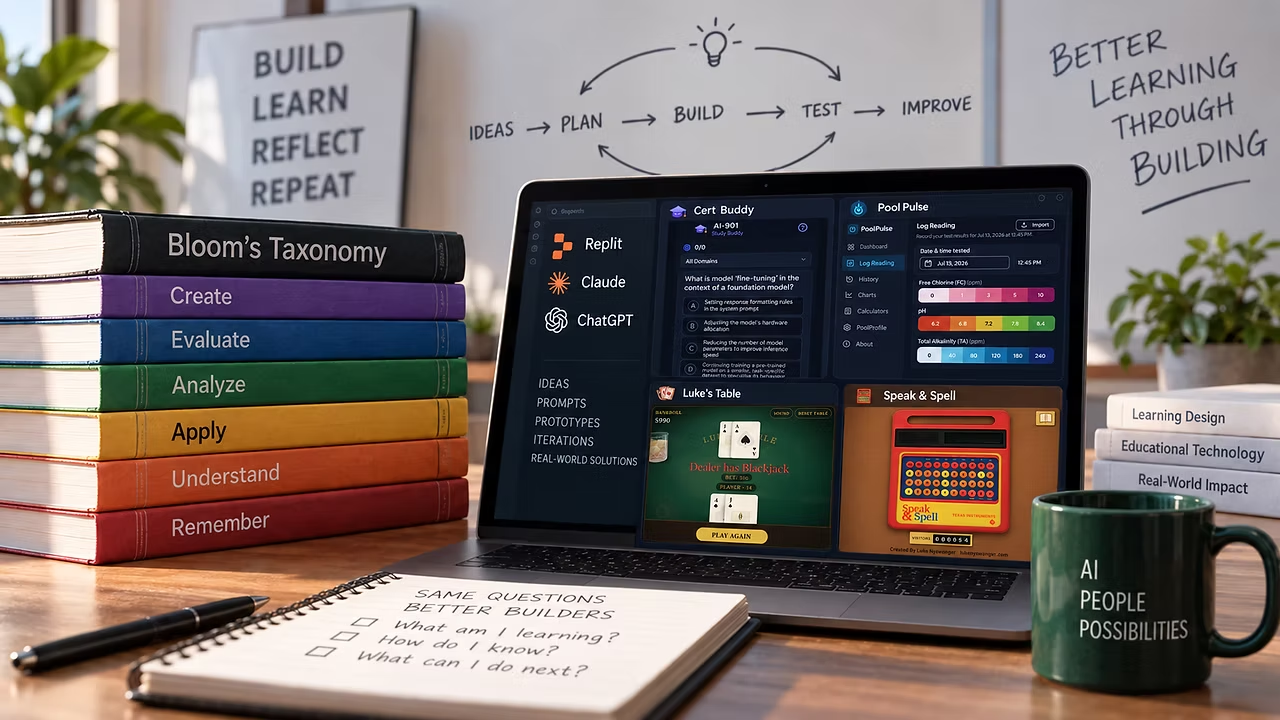
Studying Bloom’s taxonomy more deeply in graduate school has me looking differently at how I’ve been spending my time. Over the past several months, I’ve put hundreds of hours into exploring AI-assisted development, building applications, , and figuring out why something that looked promising on the first attempt still needed a lot of work.
Now, as I pursue my M.S. in Learning Design and Technology at George Mason University, I’m connecting that experience to the theory we’re studying. Bloom’s has given me a useful question to sit with:
When AI helps me create something, what am I actually learning?
That question also connects directly to our coursework. My project team within the cohort is developing an instructional design project focused on helping K–12 teachers use AI-assisted development, often called vibe coding, to adapt lessons into digital experiences that support different learning needs. We’re working through needs analysis, task analysis, and learning objectives, with Bloom’s taxonomy central to how we think about those objectives.
We have to get specific about what teachers should be able to do. “Understand AI” leaves a lot unanswered. Should someone explain when an AI-assisted activity would be appropriate? Identify a problem in a generated activity? Evaluate it against learning and accessibility criteria? Create and revise an experience for a particular lesson? Each choice has implications for what we teach and what evidence of learning we ask for. That has made me turn the same questions back on myself.
The revised Bloom’s taxonomy describes six categories of cognitive processes: remember, understand, apply, analyze, evaluate, and create. In everyday terms, these involve recalling information, explaining meaning, using a procedure, examining relationships, making judgments against criteria, and developing something new. The framework helps classify learning objectives, and its categories can overlap.
Looking at my own work, I can see examples throughout those categories. My recent projects include:
Cert Buddy, an AI-powered Microsoft certification learning product that I founded and launched. This is the project I’ve taken to market, which means learning from actual users alongside building features, refining onboarding, and experimenting with different ways to support study.
Pool Pulse, a working application for tracking pool chemistry and making the results easier to interpret. It gave me a practical setting for working through data, application logic, and user guidance.
Luke’s Table, a blackjack game that gave me room to experiment with visual design, sound, and interaction. Small details, such as how betting chips move or when a control should be available, became problems to work through.
My Speak & Spell recreation, which started with nostalgia and led me into speech, interface behavior, and the details of recreating a familiar learning experience.
A Technical Content Dashboard, an experiment in managing the freshness, quality, and ongoing maintenance of a large collection of technical documentation. It connects directly to challenges I’ve spent years thinking about professionally.
Galactic Vault, a trading card collection app built to scan, identify, and organize Star Wars cards across sets. It's giving me a chance to work through image-based workflows, collection data, duplicate tracking, set completion, and ways to connect a physical hobby with a useful digital experience.
There’s a longer thread here, too. Earlier projects from 2022 such as Homebrewing.ai explored teaching AI through a familiar hobby. My Power BI brewing dashboard used my own brewing data to learn a tool and then explain the process to others. Choosing something I care about has consistently given me a reason to keep learning when the work gets difficult.
With the recent builds, tools such as Claude Code, Cursor, Lovable, Replit, and ChatGPT have helped me move quickly enough to explore more ideas. They’ve also made it possible to start building before I fully understand every technical component involved.
That’s where my initial question about Bloom’s gets interesting. I see a lot of my work in analyze, evaluate, and create. I’m defining problems, examining how an experience behaves, judging the results, and bringing pieces together into something people can use. At the same time, I’m still developing foundational knowledge in specific technical areas.
I can draw on decades of experience in learning and technology to design a product while needing help understanding an unfamiliar implementation detail. Both can be true during the same afternoon.
The Speak & Spell project provides a small example. An early version had a CLUE button that looked right but didn’t do anything. Before fixing it, I needed to investigate what that function actually did, when it was available, and what feedback it gave the learner. Then I could turn those findings into requirements and test the revised interaction. I wrote about that process here.
Through Bloom’s, I can describe several kinds of thinking inside that one change: understanding the original behavior, analyzing the interaction, and evaluating the result against what I intended. Creating the application involved repeatedly working through those questions.
Cert Buddy adds another dimension because people are using it to study. For example, connecting it to Microsoft Learn involved a decision about where the AI experience should get its technical information. My background helped me recognize the importance of current documentation. Building the connection gave me a reason to deepen my understanding of how that information could become part of a personalized learning experience.
Still, having a working feature doesn’t tell me everything about what I’ve learned. I need to ask whether I can explain the decision behind it, recognize a problem, and use what I learned when a different project presents a similar challenge. If I’m repeatedly asking AI to fix something I can’t explain, that’s a useful signal to slow down and investigate.
This is also shaping how I think about our cohort project. A teacher could generate an attractive activity and still need support judging whether it serves the lesson. As we develop objectives, we need to consider both the experience teachers produce and the reasoning they demonstrate along the way.
For example, an objective could ask teachers to evaluate a generated activity against a rubric and explain which issues need revision. Another could ask them to create and revise an activity for a specified lesson goal, showing how it meets the agreed criteria. Those are possible directions as we build out the objectives. The task, conditions, and evidence all need to make sense together.
Working on this project while building my own applications puts me on both sides of the learning experience. I’m thinking about what support teachers will need while noticing where I need more support myself.
That’s been one of the most useful parts of returning to school. I have years of experience to bring to the coursework, and the coursework is giving me better questions to bring to my experience. The next time I finish a feature, I want to be able to explain what I understand now that I didn’t understand when I started.