
Building Blackjack with AI: Why the Details Matter

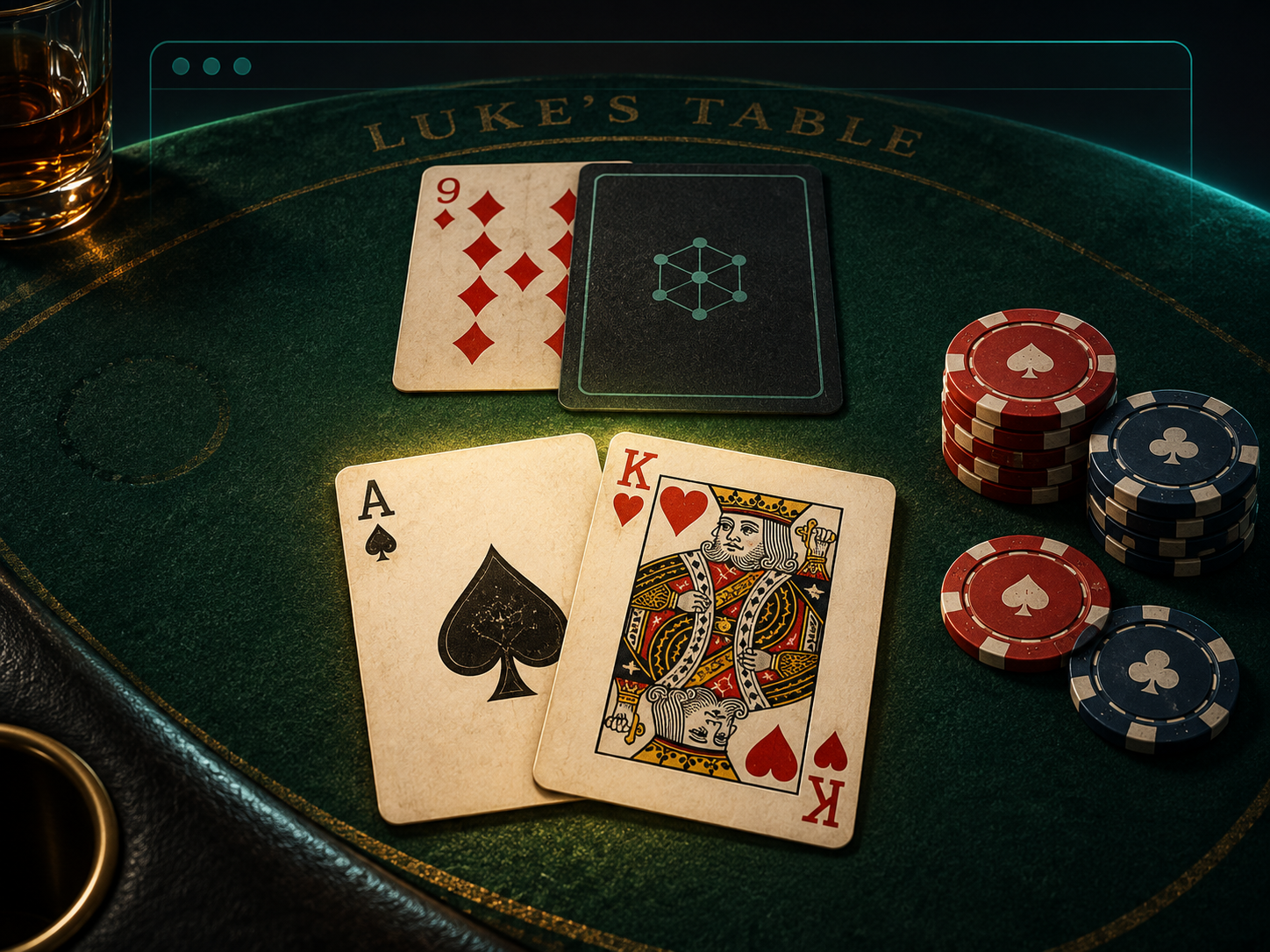
I set out to build a blackjack game for fun. Before long, I was thinking about how the cards should land, how the chips should move, and what the table should sound like.
I’ve been spending a lot of time exploring AI-assisted development across different projects, and a blackjack table gave me another place to experiment with interaction, visual design, and sound.
The result is Luke’s Table, a browser-based game with worn green felt, animated cards, chips you can throw around, and a little casino atmosphere.
♥️♦️♣️♠️ Play Blackjack 21
I used Replit as the development environment, Claude Code to help build and refine the application, ChatGPT to explore visual ideas and branding, and ElevenLabs to generate casino ambience and sound effects. Moving among those tools became part of the process, with each contributing something different. As the game came together, I found myself spending more attention on the small decisions that shaped how it felt to play.
Take the betting chips. Clicking a button to place a wager works perfectly well. But I wanted players to be able to grab a chip and throw it onto the felt. Then move it around. Stack it with another chip. Drag it back toward the controls to remove that part of the bet.
Each interaction introduced decisions. A click needed to behave differently from a drag. The chips needed to work with a mouse or a finger. Returning a chip had to refund the correct amount. Once a hand started, the wager needed to stay locked.
Something that looks playful on the surface turns out to involve quite a bit of coordination underneath.
The sound had a similar effect on the project. ElevenLabs let me create casino ambience, card sounds, and chip effects that added character to the table. Hearing a chip land makes the interaction feel more complete.
But atmosphere also needs an off switch.
I gave the background ambience and game effects separate controls, with independent volume settings and a master mute that preserves those choices. Someone might enjoy the card and chip sounds while finding continuous casino noise distracting. Turning the ambience off also needed to stop playback reliably. Even a small sound panel required attention to behavior beyond its appearance.
I wanted the table to look a little worn and scrappy, with faded felt, scuffs, and faint drink rings. Those details are built with layered CSS effects, which lets the surface adapt to different screen sizes.
I also wanted the game to feel connected to my website branding. My first attempts at the card backs borrowed heavily from my business cards: my name, website address, green accents, and network graphics. Seen on their own, the designs seemed reasonable. Once placed on the table, they felt excessive.
The table already had “Luke’s Table” printed into the felt and a link to my website. Repeating that much branding on every card was more than the experience needed. I eventually simplified the back to charcoal, a thin teal border, and a small network mark. That was a useful reminder to judge a design in the place where people will actually encounter it. Scale, repetition, and surrounding elements change how something reads.
Some of the most useful work was less visible. The dealer’s hidden card needed to remain hidden throughout the animation, including preventing a brief flash of its rank or suit during rendering. Game rules needed to hold up when someone clicked quickly or used keyboard shortcuts. A disabled button alone couldn’t carry that responsibility, so the game engine enforces those restrictions.
I also added keyboard controls for playing hands and moving chips, visible focus indicators, status announcements, and reduced motion for the Blackjack celebration. These became part of thinking through the interactions themselves: what information someone needs, which actions are available, and how they can perform them.
Those questions connect naturally to my work in learning and digital experiences. Clear feedback, understandable controls, and user choice matter in the things I build professionally, too. A small game provides a practical place to examine them closely.
My recent Speak & Spell project got me thinking about how much easier AI has made it to try an idea. Blackjack gave me more room to explore what happens as that idea develops.
AI tools helped me implement changes, generate assets, and work through problems. I still needed to play the game, notice what felt awkward, decide what mattered, and keep revising. Sometimes that meant adding a capability. Sometimes it meant removing something I had just spent time creating.
There’s something useful about studying those decisions through a project you enjoy. You make a change, play another hand, and discover another detail worth fixing.
Occasionally, you even get blackjack.
♥️♦️♣️♠️ Play Blackjack 21